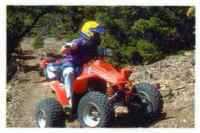
By taking a short walk up the slope to the east, you can get a sweeping panorama of Mount Baldy, Mount Belknap, Gold Mountain, and Copper Belt Peak to the north. To the west is the Basin and Range Province, with mountain chains marching off to the west. To the south are Shelly Baldy Peak, Big Johns Flat, Circleville Mountain, Mt. Holly, and Delano Peak. On a crisp September day the view is like a fine white wine; clear and exhilarating. South of the pass, the trail leads down a series of six switchbacks to Mud Lake and Big Johns Flat. After Big Johns Flat the trail leaves the road to follow a true trail down Sawmill Ridge. Here it passes through aspen and conifer with manzanita and prostrate juniper on the ground. There is the sweet smell of pine and in the fall the splash of color as yellow aspen leaves fall on green conifer boughs. As this is a trail, roots and rocks make travel more difficult than on the roads. South of the trailhead in Merchant Valley is the first of a series of short steep stretches in the trail. After crossing the pavement on Utah Highway 153, where you should be careful of traffic, the trail heads downhill on a wide road. Then above the meadow on Lake Stream, upstream of Three Creeks Reservoir, the trail takes a sharp turn back to the right. This turn is easy to miss. At the lower end of this meadow Lake Stream has cut a 30-foot high slot through an outcrop of the volcanic rocks that comprise most of the Tushars. Leaving this meadow, the trail again becomes narrow and steep until it reaches the south end of Big Flat. Big Flat is a rolling opening in the forests that cover the Tushar Mountains. It is a dry grassland at the south end and wet meadows at the north. During the summer months, it is an excellent place to observe deer and elk as they come out to graze at twilight. As the soils are easily eroded, travel is not permitted on Big Flat, to protect the grassland. Utah Highway 153 is also closed to ATV travel. From Big Flat to Bettenson Flat the trail follows old logging roads through tunnels of conifers and cool, tall, straight aspen, and then out through openings onto grass meadows. At places the trail passes old logging operations that are slowly re-vegetating with conifers; at other places it passes old burns that are filled in with dense stands of aspen. The trim line at the base of the aspen is from deer and elk browsing on tender shoots. There are scattered areas for camping along this section of trail and along the old logging road on the east side of Big Flat. This side trail leads to a trailhead and comfort station at Tippits Spring, near the north end of the flat. There is also a trailhead along the trail at the south end of Big Flat. At the approach to the South Fork of City Creek there is an area of little vegetation and eroding soil. This degraded watershed is a small example of what much of the country looked like around the turn of the century, when lack of management allowed transient livestock to overgraze. This practice led to severe problems for valley residents because of floods and lack of summer pasture for their livestock. Local valley residents then petitioned the federal government to solve the problem; resulting in the eventual creation of the National Forests. Although there has been tremendous improvement, for example in some areas grazing was seven times what it is today, problem areas like this one remain. At the south end of Bettenson Flat there is a tremendous view northward toward the higher peaks of the Tushars. These are the peaks the trail goes between several miles to the north. The trail turns eastward into the woods toward the south end of Bettenson Flat and quickly becomes steep and narrow. After a short rise it starts down a series of eleven tight switchbacks. Some are so tight that it may be necessary to back up to complete the turn. It would be extremely difficult to get a trailer through this section. Rocks on the inside of this section add to the difficulty. Most of this section is tree lined, but at the openings there are spectacular views of Circle and Panguitch Valleys to the south. The vegetation through this section leads from conifer down through mountain mahogany to snowberry with lupine. Finally the trail crosses a sagebrush slope studded with wild flowers before entering Wades Canyon. Wades Canyon is bordered by steep cliffs of volcanic conglomerate. Vegetation in the canyon is fir, spruce, aspen, ponderosa pine, and cottonwood. The wide variety of species is due to the cold air drainage which allows species normally found at higher elevations to exist here. It also makes for cool riding. At the mouth of the canyon the trail breaks out onto an alluvial fan composed of the material eroded from Wades Canyon. Here the vegetation is first oak brush, then pinyon-juniper; and finally sagebrush. This road across the fan and into Circleville can be fast, but be cautious of the mounds created to divert water off the road. Also watch for oncoming traffic and sudden rough spots.
continued next page
|