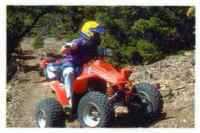
The trail then descends into Kingston Canyon along a dry wash that is also a utility right-of-way. This segment of the trail is one of the roughest, and combined with some short, steep pitches is moderately difficult. However the trail does cross Rocky Ford Creek and the East Fork of the Sevier River on bridges before reaching Utah Highway 62. The crossing of Highway 62 provides a potential trail head for those wishing to ride the higher elevations of the Sevier Plateau. The trail follows Forest access Road 068 out of Kingston Canyon and onto the south end of the Sevier Plateau. This is a good road that allows fast travel, but it also is the main access to the south end of the Sevier Plateau so there probably will be other traffic. Caution is required. The trail passes through woodlands of pinyon and juniper Rock outcrops are volcanic conglomerates deposited by violent floods, which resulted from thunderstorms caused by the eruptions of the volcanoes. After about five miles of climbing, the trail enters the Fishlake Forest on a sage flat. East of the trail is the rim of Forshea Mountain where the rocks have been eroded into pinnacles and spires. To the west are views of the Tushars, third highest mountain range in Utah. Northward is the town of Marysvale in its valley. Near the turn of the century this town was sustained by gold and silver mining in the Tushars. In the forties, fifties, and sixties uranium mining in the hills north and east of the town was the primary employment. From about the head of Pole Canyon the trail crosses the Sevier Plateau, a rolling upland. Views to the west are of the Tushars while those to the east are of Grass Valley, Parker Mountain, the Aquarius Plateau, Thousand Lake Mountain, and Boulder Mountain. The trail follows a dirt road, Forest Road 068, that permits easy travel, except for a few bumps and ruts. The south end of the plateau is covered with sage that gives way to aspen and spruce fir stands to the north. In the 1950s patches of sage were killed by chemical spraying and the area was replanted with grasses. In the 1980s fire was used to remove the sage and restore the grasses. Fire was also used in some stands of subalpine fir to rejuvenate the aspen that was being crowded out. Aspen will sprout from the roots after a fire, but the fir is killed. Aspen shoots provide browse for wildlife; later the trees provide cover. Near the head of Langdon Creek the trail turns west on to Forest Road 070. At the head of Dry Creek, the main trail meets the east leg of the Marysvale Loop. This loop is described in a following chapter. The area around Dry Creek Guard Station provides several areas for camping. The guard station was once heavily used by rangers patrolling the mountain. The trail then continues on a good road which provides easy travel through grassy meadows and through aspen and conifer stands until it winds past Manning Meadow Reservoir. On a hot summer's day this reservoir looks very inviting for a swim to cool off. But at this elevation, close to 10,000 feet, the water never is really warm enough for swimming. The trail soon enters the Box Creek drainage on Forest Road 078. At Lower Box Creek Reservoir the trail comes out onto sage flats and starts down the mountain. Lower Box Creek Reservoir is marked by a prominent yellow clay pit. Material from this pit is transported to the Salt Lake City area and used in making refractory, or heat resistant bricks. Before starting down the mountain, you might find it worthwhile to stop and fish the Box Creek Reservoirs. North of Box Creek Reservoirs the trail continues across sage flats with scattered stands of aspen. Mountain meadows, surrounded by spruce, fir and aspen forests, provide forage for elk and deer At dusk or dawn riders often can see these magnificent animals grazing in the meadows or ambling across openings. There are views of the mountains to the east; they are Boobe Hole Mountain, Fish Lake Hightop, and Mytoge Mountain. From the junction of Forest Roads 068 and 076 the main trail follows 076 to the east. However it is only about a two-mile side trip northwesterly on 068 to the Koosharem Guard Station. This is the oldest Forest Service guard station in Utah. It was built in 1911, four years after the Forest Reserve, predecessor to the National Forest, was proclaimed. It is now being restored and will serve as an interpretive site to show what things were like when horses were the main means of travel in the western mountains. Milos Kitchen, located just below a low cliff, is an excellent place for camping. Here the trail leaves the road to follow an old horse trail down the side of the mountain, before returning to the main road and on into Koosharem. While fun and easy to ride, roads and trails on this side of the Sevier Plateau are extremely slippery when wet. When dry they can provide fast going.
continued next page
|