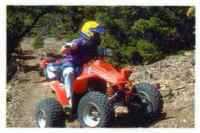
The eastern leg out of Marysvale is quite different from the western one. Instead of starting to rise straight out of town, the trail first descends to the Sevier River. After crossing this river, the trail heads northward across the Sevier's floodplain, which is lush green farm land. As the trail rises out of the floodplain it turns about 150 degrees and heads southward toward the mouth of Dry Creek. There are numerous uranium mines in this area that were active in the 1940s and 1950s. In fact, with gold and silver in the first part of the century and uranium in the middle part, Marysvale's history is closely tied to the mining of its surrounding mountains. From the southward turn to the mouth of Dry Creek Can yon the road crosses a gently rolling sagebrush plain. The road is generally smooth with good sight distances, but never-the-less requires caution. Entering Dry Fork Canyon the character of the road changes dramatically; the canyon is very narrow, the road rough, and sight distances are short. From the sagebrush the road rapidly enters the riparian vegetation of cottonwood and willow while the hillsides go from pinyon and juniper to spruce and fir. Openings in the vegetation provide spectacular views of volcanic cliffs rising on both sides of the canyon. When the trail suddenly breaks out into more gentle topography this leg of the Marysvale Loop joins the main Paiute Trail.
continued next page
|