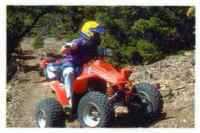
The trail passes four picnic grounds from Copleys Cove upstream to Pistol Rock. The cool shade of the cotton woods and the babbling of the creek make this stretch of the canyon a favorite picnicking area. Because of this use, there can be considerable traffic along this segment of the trail. Near Pistol Rock picnic ground the rocks are contorted and in places stand vertically. The folding of the rocks resulted from the collision of two continental plates, forming a range of high mountains in this area about 70 million years ago. The front of this mountain range is still visible a short distance up the trail. Near Pistol Rock picnic ground the trail enters several switchbacks as it climbs out of the canyon along the steep north side. Leaving the lush vegetation of the stream bottom the trail winds past stands of pinyon juniper and mountain mahogany. At first the rocks are brown quartzite, these give way to black shells that are easily eroded, and these in turn give way to grey limestone. This is the core of the ancient mountain range that once occupied this site. About a mile and a half beyond the canyon bottom the trail comes out on a promontory that affords spectacular views up and down the canyon. Across the canyon the rocks are grey limestones similar to the ones at the overlook. However, the red cliffs to the east are composed of cobbles and boulders, the debris shed from the ancient mountains. The contact between the red and grey rocks is an ancient landscape that has been buried for about 70 million years. After half a dozen more switchbacks the trail breaks onto the gentler ground of the ridge top. It continues to climb, but the gradient is gentler. Here the thin red soils support grasslands interspersed with clumps of mountain mahogany and of aspen. As the trail nears the junction with the main Paiute Trail there are views of parallel trenches across the hillsides. These were constructed in the 1960's to retard flood runoff from this land, which had been denuded by overgrazing around the turn of the century. Then just before the junction there are views of Beehive Peak to the east and the Sevier River Valley beyond. From the Bear Hollow Road southward to White Pine Peak the trail alternates between open sage meadows and cool groves of aspen, spruce, and fir. Since the ridge top is fairly narrow, there are sweeping panoramas from the meadows. Here one can see all the mountain ranges traversed by the Paiute ATV Trail. At the turn to White Pine Peak the trail starts down the southern leg of the Fillmore Loop. About a half a mile along this road there is a branch to the north that leads to White Pine Peak, a radio facility at 10,215 feet with sweeping views of the surrounding valleys. The south branch of the road is the south leg of the Fillmore Loop, which continues on down the mountain. At places the road is relatively steep, gravely, and has sudden turns so caution is necessary to keep the vehicle in control. Near the top the vegetation is spruce and fir trees with clumps of aspen. This gives way to aspen, then mountain mahogany, then oak brush before breaking out onto the sagebrush slopes above Fillmore. Along this leg of the Fillmore Loop there are several grassy clearings that would make good camping spots. In one clearing there is an old rain gage that was used to measure the amount of precipitation needing control by the watershed protection trenches. After breaking out onto the gentler and more open lower slopes of the mountain the trail provides views west to Pahvant Valley, which was once flooded by Lake Bonneville, and east to spectacular yellow rock outcrops. From there the loop is completed by following county roads into Fillmore.
continued next page
|