GENERAL GENERAL
For each trail section, the description follows the same pattern: 1) Travel times; 2) A short list of the elevations the trail reaches; and 3) A brief overview of the trail including general trail conditions, things to be seen, points of interest, etc. The travel times are based on a moderate rate of speed that includes stops along the way to view the scenery, take pictures, make notes, and stretch legs. Undoubtedly some can travel the sections in shorter times, but they will certainly miss some of the area's scenery.
Richfield to Fremont Indian State Park
The ride from Richfield to Fremont Indian State Park, in Clear Creek Canyon, takes about four hours. Intermediate times for this portion of the trail are as follows: Approximate Section Time
· Richfield to junction with main trail 0.5 hr
· Main trail to Second Creek Road 1.5 hrs
· Second Creek Road to Clear Creek Road 0.75 hr
· Clear Creek Road to Fremont Indian State Park 1 hr
From the 5,400 foot elevation of the Sevier River Valley at Richfield this segment of the Paiute Trail rises to 8,000 feet along the southern portion of the Pahvant Range before descending to 6,500 feet in the valley of Second Creek. The trail then rises to 7,200 feet at the Second Creek divide with Grass Creek and then ends at Fremont Indian State Park at 5,800 feet. 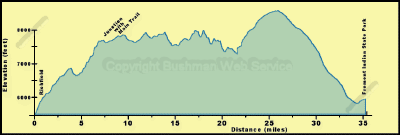
The access road from Richfield to the main Paiute ATV Trail follows Forest Road 096 known locally as the CC road because it was built by the Civilian Conservation Corps. This is side loop 04 of the Paiute ATV Trail. The road rises through red rock formations that nature has sculptured into fantastic shapes and small caves. Along the road there are many panoramic views of the green valley of the Sevier River. The green contrasts with the reds of the nearby rocks and the dark green pigmy forests of pinyon and juniper. This road can be rough, especially after flash floods that wash debris over the road. Otherwise, it is intermediate-to-easy riding. Turning south from the Richfield side loop, the main trail follows a good, rolling dirt road through woodlands of oak, maple, mahogany, pinyon, and juniper. These woodlands are interspersed with grass and sage meadows that have been recreated by chaining the woodlands and reseeding with grasses. South of the side road leading east down Albinus Canyon to Elsinore the trail is good, but slightly steeper. This is caused by a change in the underlying rocks to volcanics from the Tushar Mountains. Vegetation along the trail is mainly oak brush with conifers in the bottoms. Openings along the trail provide spectacular views of the deserts in the Great Basin to the west. In the Great Basin no river reaches the oceans. An opening in the vegetation on a point west of Cummings Creek gives a great panoramic view. The trail soon reaches the Second Creek Road (Forest Road 106). This road allows for some fast travel, but beware of ruts in the road and potential traffic which can use this road. At the broad, open divide between the Second Creek and Grass Creek drainages there are spectacular views of the Tushar Mountains to the south. These are the third highest mountains in Utah and are snowcapped throughout much of the year. From the divide down to Clear Creek, the trail passes through an area of intermingled private and National Forest land that provides pastoral scenery. Three Creeks Reservoir is to the east. Crossing Utah Highway 4, the trail parallels this road for a short distance before heading up Shingle Creek. This short stretch of the trail is slow going. The trail then follows a good road up Shingle Creek and passes beneath two massive bridges carrying Interstate 70 high over the creek. The trail leaves this road at the revegetated pit where they excavated the material for I-70. From Shingle Creek to Mill Creek, to the east, the trail follows old horse trails and roads where grass grows between the wheel tracks. There are several short, steep pitches along this stretch. Also, the trail crosses Fish Creek three times. As with the area of Three Creeks, there are grand views of the Tushar Mountains to the south. Much of the trail is through woodlands of pinyon and juniper, cleared by chaining in several places. These clearings permit the rider to compare the closed canopy stands containing no grass understory with the open grasslands that have been created. Arriving at the Mill Creek Road (Forest Road 113) the rider can turn south to follow the main trail, described in the next section, or turn north to go to Fremont Indian State Park. Fremont Park is about four miles from the turn onto Mill Creek Road. This road is smooth and provides for fast travel so be careful of other traffic. The massive Mill Creek bridge for I-70 and the exotically eroded towers, or hoodoos, near Castle Rock provide the scenery along this stretch of the trail. Castle Rock Camp ground is accessible by crossing a bridge and following Forest road 478 for about a mile. Fremont Indian State Park provides a trailhead as well as an excellent museum of prehistoric Native American relics. 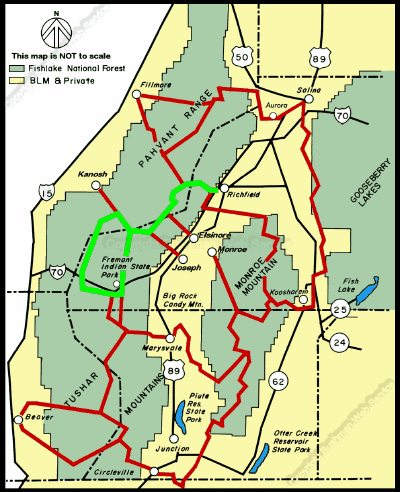
continued next page |