| The clearing on the right side of the road (north) is where the main Boarding house is said to have stood. Little remains of the one-story, wood-frames buildings ecept for a few scattered artifacts. The clientele of the boarding hose were mostly single men who sought employment in the gold fields. In the late 1800's, the cost of staying in an accommodations like this could have been as high as $11 a week with meals priced from $0.50 to $1.00. With wages ranging between $2.00 and $4.00 a day for laborers, muckers (shovelers), timbermen, carmen and blacksmiths, most made only enough to provide the bare essentials. On the opposite side of the road, to the south and accros the creek are the remains of the Dalton Mill (later renamed the Sylvester-Soderberg Mill). Built sometine before 1900, the only reminders of the mill are the concrete foundations, a large flat pile of tan-colored tailings and rusted equipment which can be seen through the trees. When in operation the mill received ore from a narrow gauge railroad that entered the top of the building about 250 feet up the slope of the canyon. Fed by gravity, ore moved downhill where it was mechanically crushed and pulverized along the way. At the bottom of the plant, gold ore was concentrated and shipped to great Britain, and later to Salt Lake City, where a smelter would create pure bars of gold bullion. Mines using the mill included The Wedge, Bully Boy, and Dalton. | 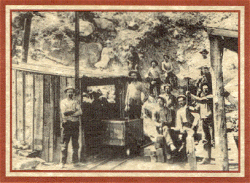
Photo Courtesy Utah State Historic Society The Dalton Mill processed tens of thousands of tons of ore from mines like this one 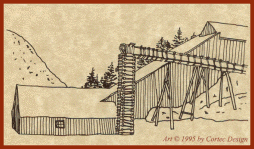
Some "old timers" suggest that the Dalton Mill may have burned down in 1914.
|